
The bunk bed market is larger and more varied than most buyers realize. At one end sits affordable flat-pack furniture designed primarily for children's bedrooms. At the other, a small but growing category of enclosed, modular sleep pods built for shared environments.
Three names recur consistently in buyer research: IKEA, Ashley Furniture, and NapBox. Each occupies a distinct position. Understanding that distinction makes for a more informed purchase — whether the context is a family home, a small rental property, or a shared living arrangement.
IKEA
IKEA — Accessible, Familiar, Functional
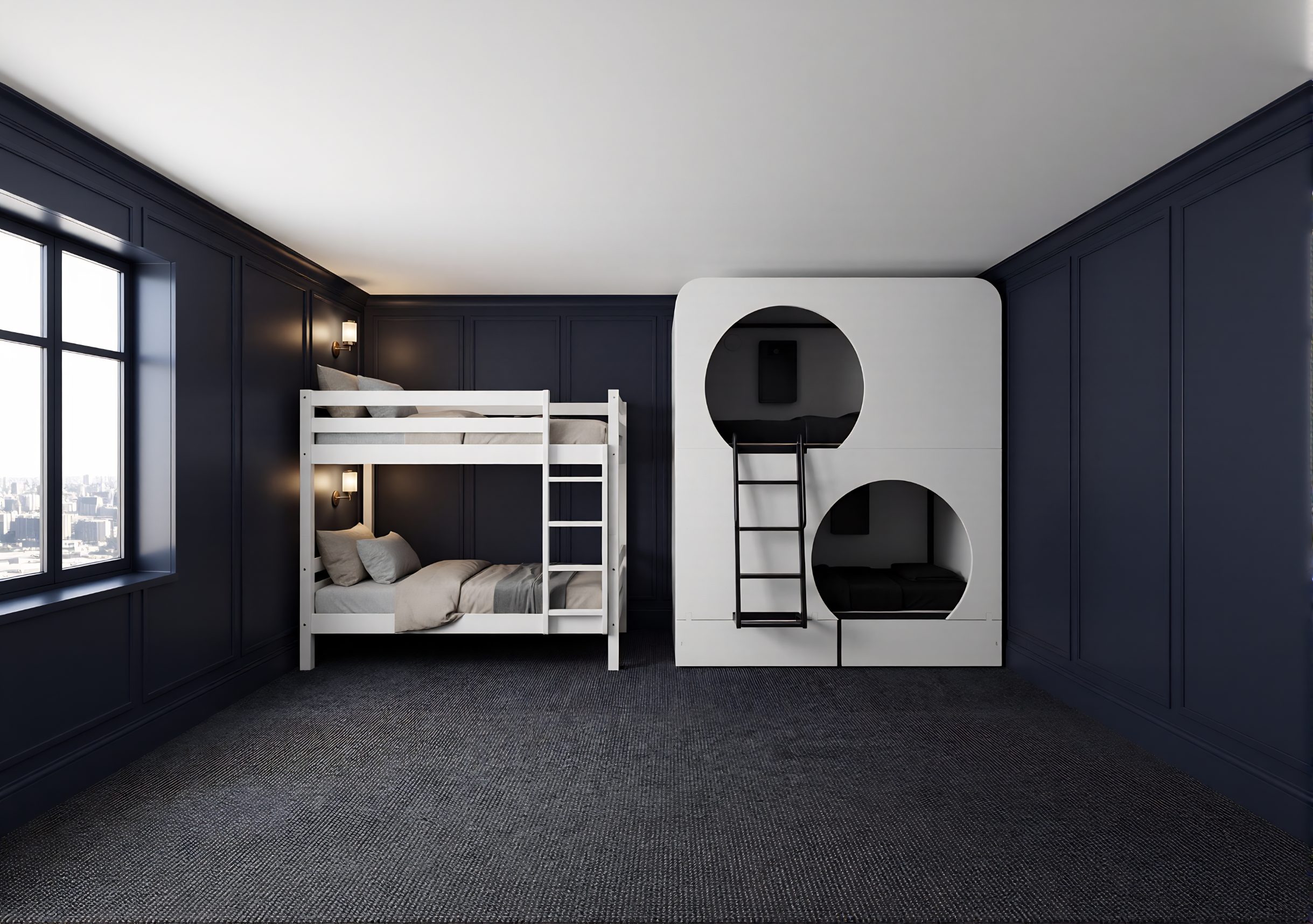
IKEA's bunk bed lineup (MYDAL, TUFFING, VITVAL) has earned its place in millions of homes for good reason. The prices are honest, and the brand is trusted globally. For a family outfitting a kid's bedroom, it's a genuinely solid choice. Assembly is time-intensive but well-documented, and the aesthetic is clean enough to work in most interiors.
The constraint is structural. IKEA bunk beds are open-frame designs: there is no acoustic or visual separation between sleepers, no integrated utilities, and no straightforward path to reconfiguration once assembled. For a child in a private bedroom, none of this matters. For two adults sharing a space, the implications are more significant.
ASHLEY FURNITURE
ASHLEY FURNITURE — Broad Range, Traditional Execution
Ashley Furniture is the largest furniture manufacturer in the United States by revenue, and its bunk bed range reflects that scale. Styles run from farmhouse timber to contemporary panel designs, with several models incorporating storage drawers — practical additions for rooms where storage space is limited.
Ashley's build quality is solid. The frames are heavier and more decorative than IKEA's, which reads as higher quality in hospitality settings where perceived value matters. For small operators — boutique rentals, family lodges — an Ashley bunk presents well without requiring a significant capital outlay.
Functionally, however, Ashley beds share the same limitations as the broader traditional category. Open-frame construction, no privacy provisions, no built-in amenities, and difficult to relocate once assembled. These are not criticisms specific to Ashley — they are characteristics of conventional bunk bed design across the board.
NAPBOX
NAPBOX - A Different Premise Entirely
NapBox was developed around a question that traditional bunk bed manufacturers have not formally addressed: what does a shared sleeping environment require to support genuinely comfortable, private, hygienic rest for each occupant individually?
The answer, built into the Basic Bunk Bed, is a partially enclosed pod — MDF privacy panels and a curtain that create a defined personal space for each sleeper. The effect is meaningfully different from an open-frame bunk: occupants are visually and acoustically separated in a way that conventional designs do not attempt.
A partially enclosed structure that limits airborne spread and cross-contamination — moisture-resistant panels support better hygiene in any shared environment.
That enclosure also carries hygiene implications. Moisture-resistant surfaces reduce the transmission of airborne particulates between sleepers and simplify cleaning — considerations that open-frame beds structurally cannot accommodate, regardless of manufacturer.
NapBox's unit can be fully self-assembled in under ten minutes — ready to use the same day it arrives.
Comfort Features — Premium Version
The NapBox Premium Bunk Bed version includes a dedicated set of integrated comfort amenities: a power outlet with USB-C charging, a reading light, a personal fan, a fold-out table, coat hooks, and luggage storage. In a shared sleeping context — whether a family home or a managed property — these address needs that occupants of conventional bunk beds must solve independently. Hospitality operators, in particular, typically source and retrofit charging infrastructure at additional cost; the Premium version resolves that at the product level.
AT A GLANCE
Feature Comparison
|
|
NapBox |
IKEA |
Ashley Furniture |
|
Assembly |
Lightweight modular design — self-assembly in under 10 min |
1–3 hrs |
2–4 hrs |
|
Privacy |
Enclosed pod — curtain + MDF panels |
Open frame, no separation |
Open frame, no separation |
|
Hygiene |
Moisture-resistant; limits cross-contamination |
Standard open surfaces |
Standard open surfaces |
|
Comfort Amenities |
Premium: USB-C, reading light, fan, table, coat hooks |
None |
None |
SUMMARY
Choosing the Right Bed
IKEA and Ashley Furniture are well-established answers to a well-understood problem: a safe, functional bunk bed for residential use. For that specific brief, both deliver.
NapBox addresses a different brief. Where conventional bunk beds treat shared sleeping as a space problem — solved by stacking — NapBox treats it as an experience problem: one that requires privacy, personal utilities, hygiene-conscious construction, and the flexibility to adapt. For buyers whose context fits that description, no directly comparable product exists at a similar price point.
Shared living doesn't have to mean shared discomfort. The right product changes everything.
Share:
Workplace Distractions: The Data That Will Shock You